

 The landscape for liquidation buyers in 2026 is rapidly evolving.
As discussed in our previous analysis on Why Now Is the Best Time to Start a Liquidation Business (2026 Market Trends), market conditions are creating new opportunities for buyers who can adapt quickly.
As consumer spending shifts from physical products to experiences, businesses are rethinking how inventory is sourced, used, and valued. This transformation is creating new opportunities for buyers who understand how to adapt to experiential demand.
Liquidation buyers in 2026 are facing a major shift in how inventory is sourced and used.
As the market moves from products to experiences, new opportunities are emerging for those who can adapt.
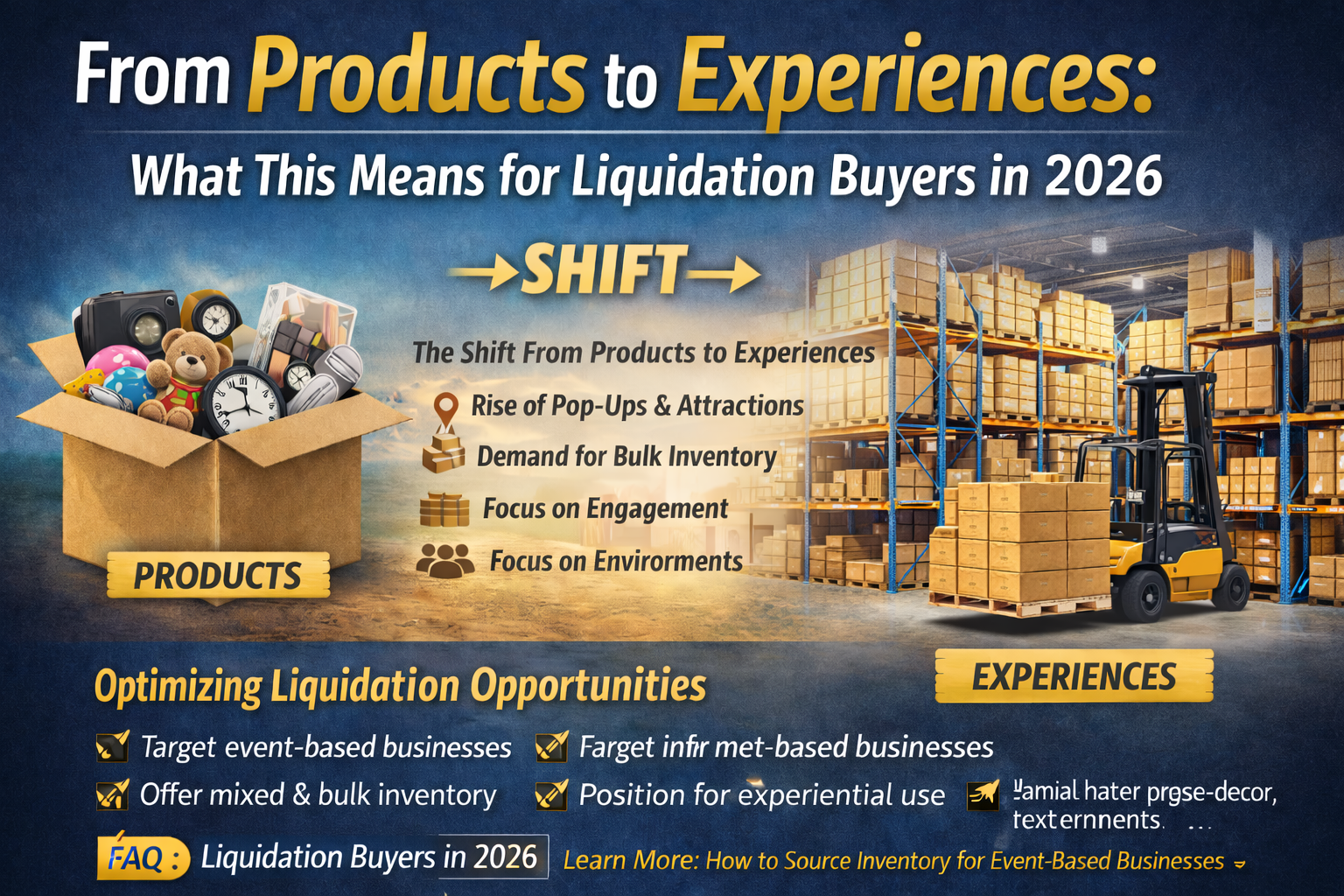
The Shift From Products to Experiences
In recent years, consumer behavior has changed significantly:
- Less spending on low-value physical products
- Increased demand for experiences, events, and activities
- Growth in pop-ups, attractions, and immersive retail
This shift means that inventory is no longer just for resale —
it is now used to create environments and experiences.
Why This Matters for Liquidation Buyers in 2026
For liquidation buyers, this trend introduces a new type of demand.
Instead of traditional retail buyers, we are seeing growth in:
- Event organizers
- Pop-up store operators
- Seasonal attraction businesses
- Experiential retail brands
These buyers require:
- Bulk inventory
- Fast sourcing
- Cost-efficient solutions
- Flexible product use
The Rising Demand for Bulk Inventory
One of the biggest impacts of this shift is the increased demand for bulk liquidation inventory.
Experience-based businesses often need:
- Props and decorations
- Display fixtures
- Themed merchandise
- General-purpose items for setup
Unlike traditional retail, these items are not always sold individually.
Instead, they are used to support large-scale setups and short-term operations.
How Liquidation Inventory Supports Experiential Businesses
Liquidation inventory offers several advantages:
Cost Efficiency
Lower acquisition costs allow businesses to allocate more budget to marketing and operations.
Speed and Availability
Large quantities can be sourced quickly, which is essential for time-sensitive events.
Versatility
Products can be repurposed across multiple events and themes.
Opportunities for Liquidation Buyers
To stay competitive in 2026, liquidation buyers should:
- Target event-based and seasonal businesses
- Offer mixed and bulk inventory solutions
- Position inventory based on use-case (not just product type)
- Understand experiential business needs
This approach allows buyers to tap into a fast-growing market segment.
Common Use Cases for Experiential Inventory
Inventory used in experience-based businesses includes:
- Event props and decor
- Temporary retail fixtures
- Giveaway or promotional items
- Supporting accessories for themed environments
This expands the traditional definition of what liquidation inventory can be used for.
Conclusion
The Future of Liquidation Buyers in 2026
As the market continues to evolve, liquidation buyers in 2026 will need to rethink traditional strategies.
Instead of focusing purely on resale margins, successful buyers will:
- Identify new customer segments such as event organizers and experiential businesses
- Source inventory that can be used in flexible and creative ways
- Build relationships with bulk buyers who prioritize speed and cost efficiency
This shift represents a long-term opportunity, not just a temporary trend. Buyers who adapt early will be better positioned to capture demand in a changing marketplace.