

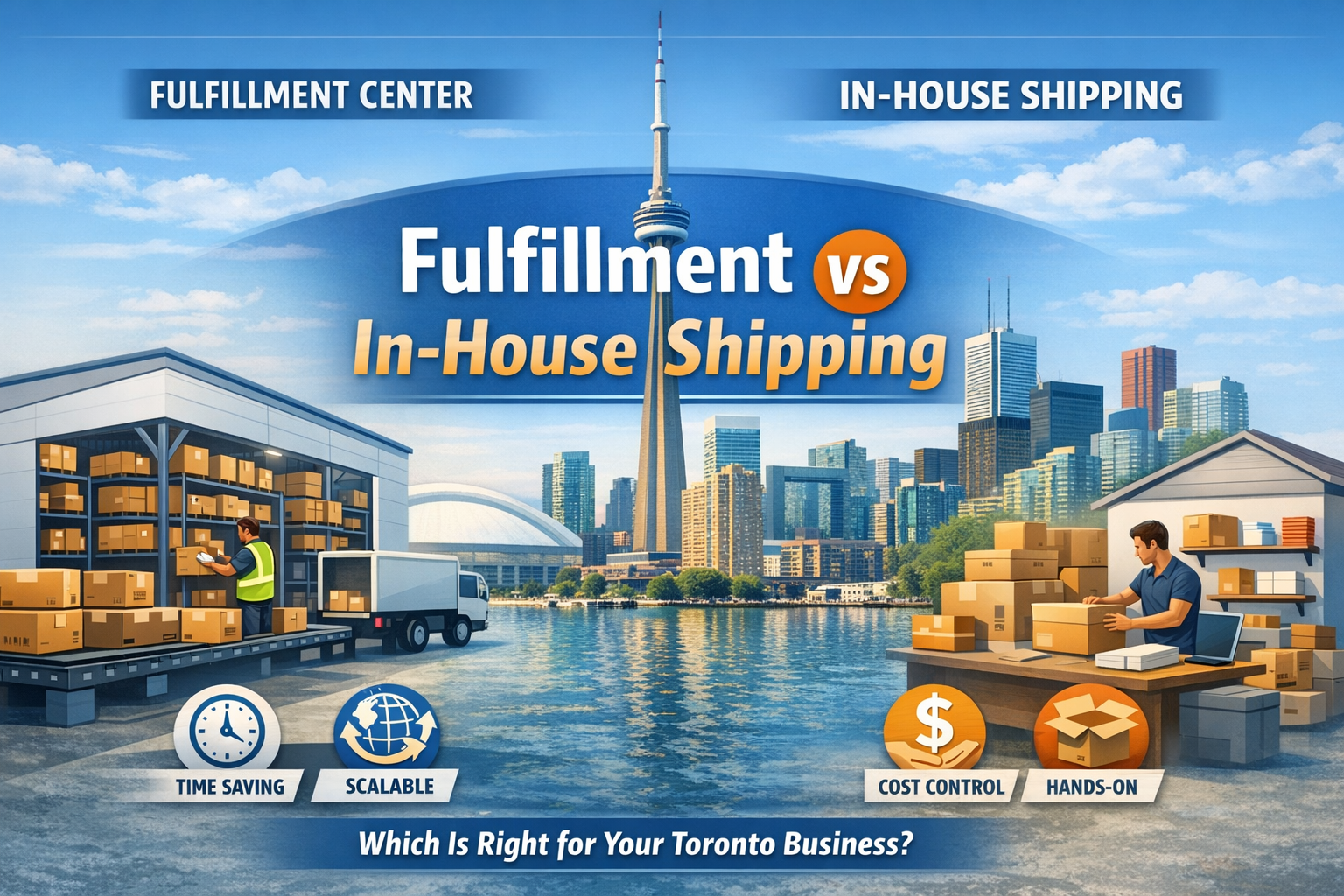
 Toronto Fulfillment Services vs In-House Shipping: Which Is Better for eCommerce?
Toronto fulfillment services are increasingly popular among eCommerce businesses that want to reduce shipping costs, save time, and scale faster. When order volume grows, many sellers must decide between using Toronto fulfillment services or continuing with in-house shipping.
Many sellers assume high shipping costs are caused by couriers, but in reality, the shipping model you choose plays a much bigger role.
For Toronto-based businesses, choosing the right shipping setup can directly affect profit margins, delivery speed, and customer satisfaction.
This guide explains the differences clearly and helps you decide which option fits your business stage.
Fulfillment vs In-House Shipping Toronto: What’s the Difference?
Fulfillment (Third-Party Warehouse / 3PL)
A fulfillment center stores your inventory and handles order processing for you.
When an order is placed, the fulfillment provider picks, packs, and ships the product.
Most fulfillment services charge:
-
Storage fees
-
Per-order handling fees
-
Additional service fees
This option is commonly used by larger sellers or marketplace businesses.
In-House Shipping
In-house shipping means you store inventory yourself and handle shipping manually.
This could be from your home, office, or a small warehouse.
You are responsible for:
-
Packing orders
-
Booking couriers
-
Handling shipping issues and customer follow-ups
This is how most Toronto eCommerce sellers start.
Fulfillment vs In-House Shipping Toronto: Pros and Cons
| Fulfillment Center | In-House Shipping |
|---|---|
| Saves time and daily labor | Full control over packaging and branding |
| Handles high order volume easily | Lower cost at small order volume |
| Structured fulfillment process | Flexible for custom or fragile items |
| Per-order fees add up quickly | Labor intensive as orders increase |
| Less control over couriers | Easy to overpay on shipping |
Which Option Is Best for Toronto Sellers?
Fulfillment Is Best If You:
-
Process 20–50+ orders per day
-
Sell on Amazon, Walmart, or multiple marketplaces
-
Want to save time and scale quickly
-
Are comfortable with fixed handling fees
In-House Shipping Is Best If You:
-
Ship 1–15 orders per day
-
Want full control over branding and packaging
-
Sell custom or made-to-order products
-
Are still testing products or demand
Do Toronto Sellers Have to Choose Only One?
No.
Many Toronto businesses now use a hybrid shipping model that sits between fulfillment and fully manual shipping.
The Hybrid Shipping Option (Popular in Toronto)
With a hybrid model, you:
-
Keep inventory in-house
-
Avoid fulfillment handling fees
-
Automatically compare multiple couriers
-
Select the most cost-effective shipping option per order
Instead of guessing which courier is cheapest, the system chooses based on:
-
Parcel size
-
Weight
-
Destination zone
-
Delivery speed
Typical results for Toronto sellers:
-
20–50% lower shipping costs
-
Fewer pricing surprises
-
Faster delivery times
Final Thoughts for Toronto eCommerce Businesses
There is no single “best” shipping model for every seller.
As your business grows, your shipping strategy should evolve with it.
If you often ask:
“Why did this shipment cost more than the last one?”
The problem is usually not the courier—it is the shipping setup.
Choosing the right shipping model can significantly improve margins, reduce stress, and create a better customer experience in a competitive market like Toronto.
For Toronto sellers comparing fulfillment vs in-house shipping Toronto, reviewing shipping performance regularly is essential. As business volume grows, the right shipping model can reduce costs, improve delivery speed, and support long-term scalability.
For more shipping insights, see our other eCommerce tips for Toronto businesses. https://www.dino-express.com/blog/